Drei Medaillen, viele Freundschaften und eine wichtige Erkenntnis.
An intense week at the World Masters Track Championships in London is now behind us. Around 500 athletes from all over the world competed at the Olympic Velodrome for medals, personal bests, and—at times—thousandths of a second. For me, these were unforgettable days filled with emotion, exciting races, and encounters that went far beyond the world of sports.
The Swiss delegation, too, can look back on these Masters World Championships with satisfaction. Despite having a significantly smaller team than last year, we’re heading home with three bronze medals. Regula Ruchti won bronze in the women’s 40–44 sprint, Domenico Semeraro finished third in the 500-meter race in the 60–64 age group, and Martin Ruepp secured bronze in the 50–54 scratch race. In addition, Andi Baumann achieved a commendable 8th-place finish in the 45–49 age group sprint. I myself am more than satisfied with my 8th-place finish in the scratch race.
The Notable Absentee: Barbara Schürch
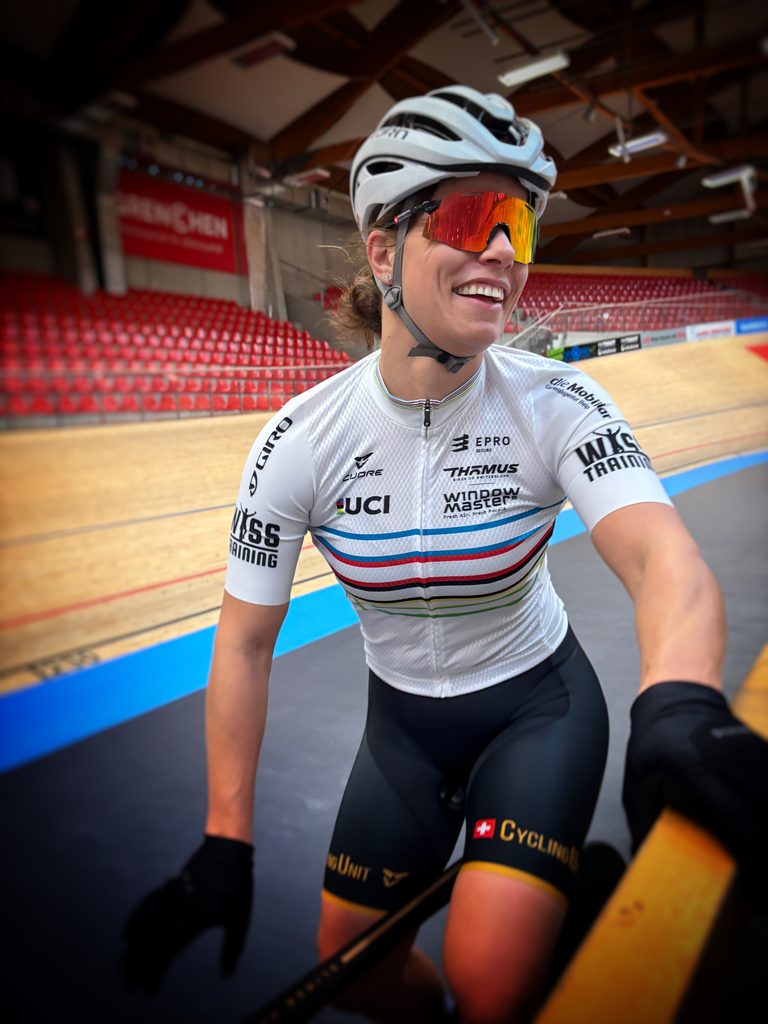
Last year, the Swiss team even won four gold medals. The fact that we weren’t able to repeat that performance this time is also due to a few notable absences. Micah Gross set different athletic priorities this season. We especially missed Barbara Schürch and her partner Marcel Wyss, who is also my head coach.
Barbara suffered life-threatening injuries in a serious car accident in mid-August. A car veered into the oncoming lane and struck her. She was in a coma and has been fighting her way back to life ever since with the very same admirable determination that made her a world champion. Anyone who knows her knows what a joyful person she is and how much positive energy she brings to our team. And she still does! Even from rehab, she sends us encouraging messages and cheers us on during our races. I’m deliberately writing in the present tense, because Barbara is part of our team. We’re all looking forward to the day when she’ll hopefully step back into the velodrome. With her and Marcel gone, we’ve been missing two exceptionally strong athletes whom I’m certain could have won several gold medals.
Enriching conversations along the railroad tracks
In addition to the races, the many conversations I had with riders from all over the world were particularly enriching for me. Above all, the exchanges with Australians and Americans—who dominate masters track cycling in various age groups—provided interesting insights. This made me realize once again just how excellent our training conditions in Switzerland actually are. With the Tissot Velodrome in Grenchen, we have first-class infrastructure, and when it comes to coaches, we certainly hold our own on the international stage. Marcel Wyss, a former professional and multiple participant in the Tour de France and the Giro d’Italia, brings a wealth of experience to the table. Joachim Ritter from Denmark oversees sprint training; Pete Mitchell from the UK shares his expertise at training camps in Anadia, Portugal, among other places; and with Stephan Bernhard, we have an outstanding athletic trainer who runs a gym right inside the velodrome.
Anyone who thinks Masters cycling is a leisurely pastime for older folks is sorely mistaken. This is top-level competition, too—with professional training plans, performance diagnostics, targeted strength training, and meticulous race preparation. This applies to the Swiss just as much as it does to the Americans and Australians. But there is one crucial difference: While Americans and Australians can regularly compete in Masters races across various age groups, we in Switzerland largely lack such racing opportunities.
There’s no substitute for racing experience
An Australian told me that he races at least once a month. Then he said something that really stuck with me: “You can’t get that intensity in training—you have to race to get it.” That’s exactly what I experienced myself in London. No matter how intensively you train for starts, accelerations, and sprints, when an opponent suddenly appears right next to you, your nerves get the better of you, and you have to make split-second decisions—it’s a whole different world.
The Masters still have a lot of potential
That’s why I see a lot of potential, especially in the Masters category. Unfortunately, the Swiss Masters Sprint Championship wasn’t widely publicized this year and, as a result, had to be canceled due to a lack of entries. It’s encouraging that the Tissot Velodrome and the Velodrome Suisse association are trying to fill this gap with race-simulation training sessions. A valuable first step. I would like to see Swiss Cycling also pay a little more attention to Masters sports in the future. As far as I can tell, last year’s four Swiss gold medals received hardly any coverage in the federation’s media. Yet, statistically speaking, cyclists over 35 make up the majority of recreational cyclists in Switzerland. Not only do they bring a wealth of experience and motivation to the sport, but they also often have the opportunity to invest time and money in it.
What remains?
So what will I take away from this week in London? The sporting memories, of course. My first scratch race, the thrilling sprint duels, and the moment when my wife and son looked at me with such pride. Just being able to compete here at all after my accident in September was a special gift for me.
But just as valuable are the people I’ve had the privilege of getting to know. These Masters World Championships are an incredible community. On the track, the competition is fierce, but off the track, people help one another, share experiences, offer tips, and celebrate each other’s achievements. Competitors become friends, regardless of nationality or age.
Thanks
Special thanks go to Yves Jäggi for his support and to Lorna, whose daily massages relieved the tension in my back muscles—which had been constantly tight since my fall—and contributed significantly to my results. My deepest gratitude goes to my family, who had to go through a lot—especially after my accident—yet always stood by me and shared all the ups and downs with me. Without you, this week would have been only half as wonderful.
I traveled to London to compete against the world’s best Masters cyclists, and I’m returning home as a top-10 scratch rider in my age group. I’m taking home many valuable insights and unforgettable experiences, which I’ve had the pleasure of sharing with you over the past few days. I hope you enjoyed my reports, and I’d like to extend my heartfelt thanks to the Grenchner Tagblatt for giving me the opportunity to take you along on this journey.
Maybe we’ll see you on December 11 and 12, 2026, at the Track Cycling Challenge at the Tissot Velodrome in Grenchen, where exciting races and thrilling showdowns await us!


